
Article: A Man’s Modern Guide to Office Dress Codes

A Man’s Modern Guide to Office Dress Codes
The right office outfit should do more than satisfy a policy. It should let you walk into a client meeting, settle into a long day at your desk, and head to dinner afterward without looking underdressed or feeling restricted. This guide to office dress codes breaks down what each standard actually calls for, so you can build a sharper work wardrobe with fewer second guesses.
Why Office Dress Codes Feel Less Clear Now
Many workplaces have relaxed their rules, but relaxed does not mean random. A tech startup, a financial office, a law firm, and a client-facing sales team may all describe their standard as “business casual,” yet the expected outfit can look very different in each setting.
The best approach is to read the room before relying on the label. Look at what well-regarded managers wear on ordinary weekdays, not only what people wear on casual Fridays. Consider whether you meet clients, lead presentations, travel for work, or move between office and social settings. Those details determine whether a crisp dress shirt and chinos are enough or whether a jacket belongs in the rotation.
Fit is the common denominator. An expensive shirt that pulls across the chest or trousers that bunch at the ankle will look less polished than well-fitting essentials in straightforward colors. Contemporary proportions, clean lines, and comfortable fabric are what make business-casual dressing feel intentional rather than stiff.
A Guide to Office Dress Codes for Men
Formal business attire
Formal business attire is the most traditional category. It is common in conservative finance, law, executive offices, formal interviews, high-stakes presentations, and ceremonies. The standard is a dark, tailored suit, a long-sleeve dress shirt, a conservative tie, a leather belt, and polished dress shoes.
White and light blue shirts are the foundation here because they work with nearly every suit and tie combination. The shirt should sit cleanly at the collar, allow room to move through the shoulders, and stay tucked without excess fabric ballooning at the waist. Save loud contrast details and casual textures for less formal settings.
A formal dress code does not require discomfort. A shirt with subtle stretch can improve movement through a full day, as long as its collar, cuffs, and fabric retain a crisp appearance. The goal is authority and precision, not an overly rigid costume.
Business professional
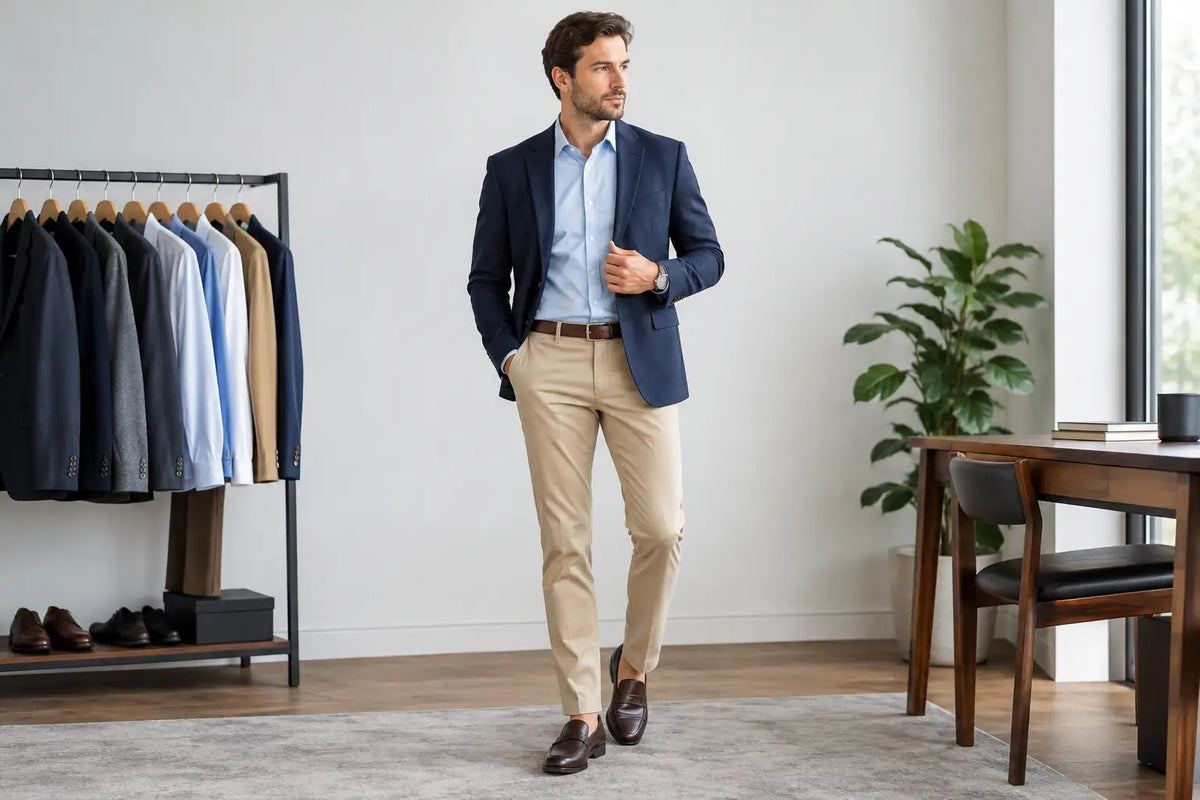
Business professional is polished but gives you slightly more room to show personal style. A suit is still often appropriate, especially when you are client-facing, but separates can work in offices where the culture is professional without being highly traditional. Think tailored navy or charcoal trousers, a refined button-up shirt, a blazer, and leather loafers or lace-up shoes.
This is the dress code where fabric quality becomes especially visible. A smooth cotton shirt, a tailored knit-stretch shirt, or a subtle micro-pattern adds dimension while keeping the look disciplined. Keep the color palette controlled: navy, gray, white, light blue, soft neutrals, and restrained patterns do the most work.
If the office environment shifts between meetings and desk work, a blazer is a practical layer. Wear it for the presentation, then remove it without losing the polished structure of the outfit underneath.
Business casual
Business casual is the foundation of many modern professional wardrobes. It replaces the expectation of a daily suit with elevated separates that still look considered. A button-up shirt, stretch chinos or performance pants, a belt, and clean leather shoes are a reliable starting point.
The key is to avoid treating business casual as casual clothing worn to work. A wrinkled shirt, faded denim, athletic sneakers, and oversized polos can make the outfit feel too relaxed, even when no one is wearing a tie. Choose pieces designed to hold their shape and maintain a clean line from morning through the commute home.
For most men, start with well-fitted shirts in white, blue, navy, and understated patterns. Pair them with chinos in khaki, stone, olive, navy, or charcoal. A contemporary-fit shirt offers a clean silhouette without the tightness of an overly slim cut, while stretch construction makes a real difference during long seated days or frequent travel.
A polished knit-stretch button-up can be particularly useful here. It carries the collar and structure of a dress shirt while delivering the softness and flexibility that a standard woven shirt may lack. That balance works well for entrepreneurs, sales professionals, and anyone whose day includes both movement and meetings.
Smart casual
Smart casual gives you more freedom, but it still asks for refinement. This dress code is common at creative companies, modern agencies, coworking spaces, and team events. You can introduce more color, texture, and personality, provided the overall result remains clean.
A casual button-up shirt with tailored chinos is a dependable choice. Dark, clean denim may be acceptable in some offices, but it depends on the culture and should never be distressed, baggy, or overly faded. Minimal leather sneakers can work in relaxed environments; loafers, chukkas, and sleek boots are safer when you are unsure.
This is also where details matter. A contrast inner collar, refined cuff detail, or subtle print can give a simple outfit more character without pushing it into weekend territory. Keep the rest of the outfit quiet so one distinctive element has room to work.
Casual office attire
A casual office dress code generally allows polos, casual button-ups, chinos, dark denim, and clean sneakers. It is still an office, though, which means gym wear, graphic tees, flip-flops, and worn-out footwear usually miss the mark.
The strongest casual office outfits rely on elevated basics rather than trend-heavy pieces. A well-cut casual shirt, super-stretch chinos, and clean low-profile sneakers look more confident than a stack of logos or overly relaxed layers. If a manager can wear the outfit in front of an unexpected client without changing, it is probably in the right range.
Build a Work Wardrobe That Covers the Week
You do not need a separate closet for every dress code. You need versatile pieces that can move up or down depending on the setting. Start with several dependable shirts, two or three tailored pants options, refined shoes, and one smart layer.
For shirts, prioritize fit first, then fabric. Your collar should sit close to the neck without pressing, the shoulder seam should align with your shoulder, and the sleeves should allow comfortable movement. A shirt that fits well looks sharper whether it is worn tucked in with a blazer or open at the collar with chinos.
For pants, choose tailored silhouettes with enough stretch to stay comfortable all day. Navy and charcoal performance pants can look polished with a dress shirt and blazer, while khaki or olive chinos bring an easier business-casual feel. Avoid extremes: trousers that are skin-tight look dated quickly, while overly loose cuts lose the clean shape an office outfit needs.
Shoes quietly set the level of formality. Polished oxfords and derbies belong with formal attire. Loafers and refined leather boots work across business professional and business casual. Minimal sneakers are best reserved for smart-casual or casual offices where they are clearly part of the culture.
How to Get the Dress Code Right Without Overthinking It
When you are new to an office, dress one level sharper than your first assumption. A button-up shirt, tailored trousers, and leather shoes rarely create the wrong impression. Once you see how the team dresses, you can adjust the formality while keeping the fit and quality consistent.
Pay attention to the calendar, too. The same office may require different choices for an internal planning day, a video call, a client lunch, and a company event. Keep a blazer, a polished pair of shoes, and a crisp shirt ready for the moments when your usual business-casual uniform needs more presence.
Avoid assuming that comfort and professionalism are competing goals. Well-designed stretch shirts and tailored performance pants make it easier to maintain a sharp appearance through a demanding schedule. LEVINAS builds its business-casual essentials around that exact idea: refined structure, modern fit, and comfort that holds up beyond the first hour of the day.
The strongest office wardrobe is not the largest one. It is the one that makes your next outfit obvious: a shirt that fits, pants that move, and finishing pieces that match the room. Dress with enough intention to show respect for the opportunity, then let your work speak for itself.

Leave a comment
This site is protected by hCaptcha and the hCaptcha Privacy Policy and Terms of Service apply.